Slower resolution times despite having multiple support tiers
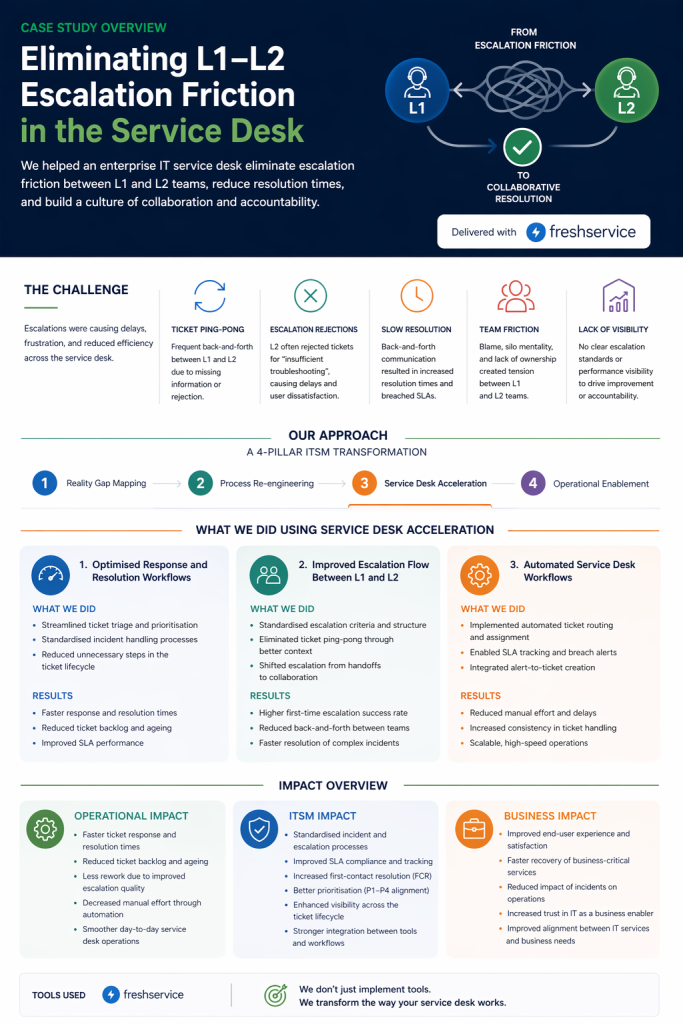
1. REALITY GAP MAPPING
The service desk was optimised for ownership boundaries, not resolution speed:
Escalations treated as handoffs instead of collaboration
No standard definition of a “good escalation”
L1 over-escalating or under-investigating
L2 rejecting tickets instead of resolving them
“Understand the gap. Redesign the flow.”
2. PROCESS RE‑ENGINEERING
Standardised Escalation Model
User Issue (clear problem statement)
Troubleshooting Performed
Findings (logs, errors, observations)
Reason for Escalation
Defined Escalation Criteria
When to escalate
When not to escalate
Expected investigation depth at L1
Shift in Operating Model
From L1 vs L2 → Shared responsibility
From handover → collaboration
3. SERVICE DESK ACCELERATION
Optimised Response and Resolution Workflows
Streamlined ticket triage and prioritisation
Standardised incident handling processes
Reduced unnecessary steps in the ticket lifecycle
Improved Escalation Flow Between L1 and L2
Standardised escalation criteria and structure
Eliminated ticket ping-pong through better context
Shifted escalation from handoffs to collaboration
Automated Service Desk Workflows
Implemented automated ticket routing and assignment
4. Operational Enablement
How We Sustained the Improvement
Integrated escalation workflows into Freshservice
Created a feedback loop between L2 → L1
Converted escalations into knowledge base articles
Gradually increased L1 capability
5. RESULTS & BUSINESS IMPACT
Operational
Faster ticket response and resolution times
Reduced ticket backlog and ageing
Less rework due to improved escalation quality
Decreased manual effort through automation
Smoother day-to-day service desk operations
ITSM
Standardised incident and escalation processes
Improved SLA compliance and tracking
Increased first-contact resolution (FCR)
Better prioritisation (P1–P4 alignment)
Enhanced visibility across the ticket lifecycle
Stronger integration between tools and workflows
Business
Improved end-user experience and satisfaction
Faster recovery of business-critical services
Reduced impact of incidents on operations
Increased trust in IT as a business enabler
Improved alignment between IT services and business needs
6. Summary
We helped an enterprise service desk overcome persistent escalation challenges that were causing delays, inefficiencies, and team friction. By applying a structured ITSM approach—focused on reality gap mapping, process re-engineering, service desk acceleration, and operational enablement—we redesigned how escalation was handled across support levels.
This included standardising escalation criteria, improving ticket quality, enabling collaboration between L1 and L2 teams, and embedding workflows within Freshservice.
As a result, the organisation achieved faster resolution times, reduced ticket back-and-forth, improved SLA performance, and a more efficient, collaborative service desk aligned to business needs.
See How This Approach Works for You
Start with a structured ITSM evaluation covering assessment, optimisation, and enablement.