The client operated a busy service desk environment with a high volume of recurring incidents and service requests. Although knowledge existed within the team, it was largely undocumented, inconsistent, or difficult to access during ticket resolution.
Knowledge was not embedded into the ticket workflow, reducing efficiency and limiting the value of self‑service and first‑line support.
1. REALITY GAP MAPPING
We began by assessing the client’s existing knowledge practices and service desk workflows.
Key gaps identified included:
Limited documented knowledge for common issues
Knowledge not linked to tickets or workflows
Poor searchability and inconsistent article structure
Over‑reliance on individual experience
“Understand the gap. Redesign the flow.”
2. PROCESS RE‑ENGINEERING
Based on the findings, we redesigned the knowledge management process to ensure it supported fast, consistent ticket resolution.
Key process changes included:
Defining standards for knowledge article creation and structure
Linking knowledge creation directly to incident resolution
Establishing ownership and review cycles for knowledge content.
This ensured knowledge was created once, maintained properly, and reused consistently across the service desk.
3. SERVICE DESK ACCELERATION
Knowledge Base Development (Freshservice)
We created over one hundred structured knowledge articles within Freshservice, focusing on high‑volume and recurring issues.
Articles were:
Clearly structured and easy to follow
Tagged and categorised for fast searching
Maintained centrally within the platform
This provided agents with a reliable, single source of truth.
Knowledge‑to‑Ticket Integration
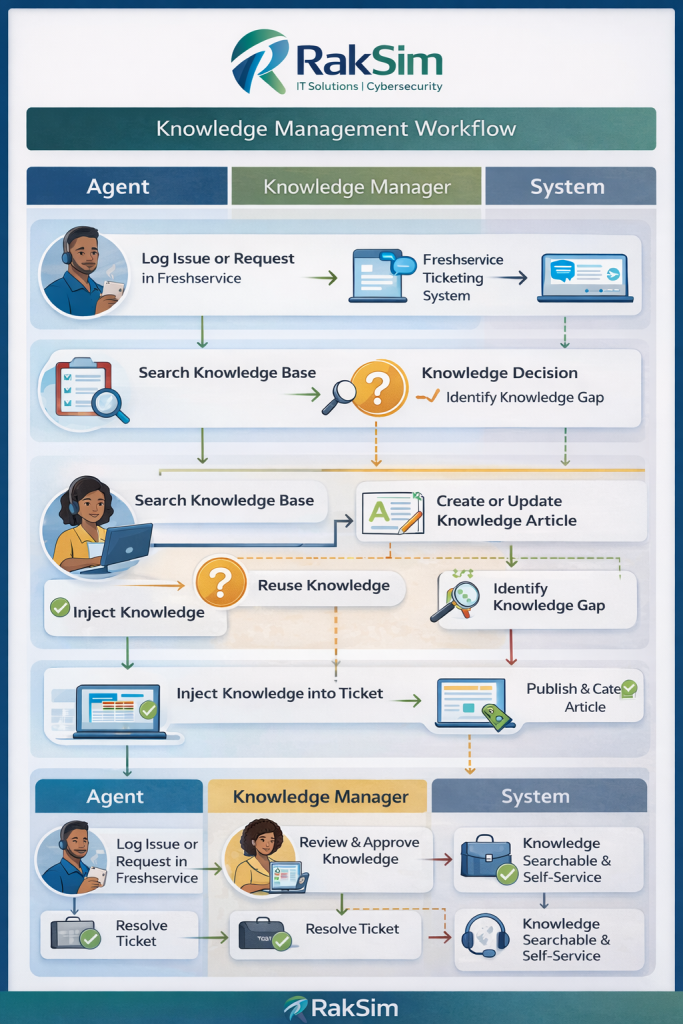
Knowledge articles were directly linked to incidents and service requests, enabling agents to:
Search for relevant articles while working on a ticket
Inject approved knowledge articles directly into ticket comments
Provide consistent, clear communication to end users
This significantly reduced resolution time and improved response consistency.
Search & Accessibility
The knowledge base was optimised to ensure:
Fast, accurate search results
Easy access during ticket handling
Increased adoption by service desk agents
Knowledge was available at the point of need, not buried in separate systems.
4. Operational Enablement
To ensure sustainability, we enabled the service desk team through:
Coaching on when and how to create knowledge articles
Embedding knowledge usage into daily workflows
Encouraging continuous improvement through knowledge reuse
This reduced reliance on individual expertise and increased overall team maturity.
5. RESULTS & BUSINESS IMPACT
Operational
Faster resolution of recurring incidents
More consistent responses across agents
Reduced dependency on senior or specialist staff
ITSM
Knowledge embedded into the incident lifecycle
Improved first‑line resolution capability
Better visibility into common issues and fixes
Business
Improved end‑user experience
Scalable support model as ticket volumes grew
Strong foundation for self‑service and future automation
6. Summary
By applying a structured ITSM improvement approach and embedding knowledge directly into Freshservice ticket workflows, the client transformed knowledge into a core operational capability.
The service desk achieved faster, more consistent ticket resolution, reduced reliance on individual expertise, and built a scalable foundation for continuous service improvement.
The next step will be to expand the Knowledge base to their self-service portal.
See How This Approach Works for You
Start with a structured ITSM evaluation covering assessment, optimisation, and enablement.